

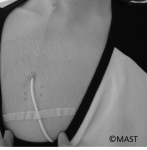
 I am on HPN…Home Parenteral Nutrition, also referred to as TPN (Total Parenteral Nutrition) or just PN. This means that every day, for between 10-14 hours, I am connected to a little machine that pumps a specially compounded infusion straight to my bloodstream. The volumes required and repeated infusions would not be possible through the kind of cannula used in hospital – that many will be familiar with – so I receive my PN through a Hickman Line™. This line is tunnelled through my chest wall through to a central vein (superior vena cava) till it reaches the right atrium of my heart. The line is not taken in and out, it’s held in place by a cuff under the skin. Where it exits, it hangs from my chest with a connecting device on the end, which is what I plug my infusion giving set into each time I set it up. The connecting (and disconnecting) procedures have many steps, but all follow what is known as Aseptic Non Touch Technique (ANNT). This technique – that I was taught in hospital and by my homecare team – is vital to keeping me safe. Anything that enters my line travels round my heart, lungs and brain, therefore entry of air, bacteria or any other organisms / material would lead to serious complications.
So why am I explaining all of this? Well as you may have already guessed from the description above, HPN and all that goes with it, comes with potentially fatal risks. It is considered a form of life support, because that is what it is doing. It is keeping me alive because I am in Intestinal Failure; I cannot get enough nutrients/fluids to survive via my intestinal tract, so it is bypassed altogether. I’m very grateful for HPN…of course because I am still here, but more than that because it allows me to be alive and at home. Originally patients like me would have had to stay in hospital to receive this, which shows what a precious opportunity home life support truly is.
However, the risk level is high, and this is something that never quite leaves my mind. I don’t mind that in itself, it keeps me on my toes, but HPN only works – works safely – when back up through emergency hospital care is available. This is what gives us the confidence to do our care or allow our carers to – the fact that although we are in our homes, we are part of a larger system…our specialist hospital units that know us and know PN, our local hospital emergency departments, our GP’s and ambulance services – that we are a team. Many of the complications that can occur require immediate medical action/support, therefore this back up is vital. All of us on HPN have been through the mill health wise, therefore we have all received a lot of hospital care, met doctors, nurses, dietitians, HCA’s and a wealth of other allied health professionals who have supported us. These highly trained and experienced professionals do an unfathomably amazing job with scant and overwhelmed resources and time.
When I see and hear so much about the current inability of the system to function as it should, to provide beds, to have the funds and resources to meet the care needs of its patients I feel many things. As a person and experienced healthcare professional myself, I feel sadness and anger, but as an HPN’er (as it were) I feel fear. I never know what day something will go wrong, I only know that statistically things will at some point. When the NHS is allowed to function, that’s okay. I put my best foot forward, add a little hope and get on with the job, but currently when I think what will happen in an emergency I feel a staccato beat of terror. What if – through no fault of their own – the emergency backup isn’t there, or it falls short.
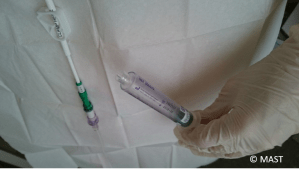 The most prominent risk is that of sepsis, where the body responds to an infection by injuring itself, causing shock and organ failure. Sepsis is a medical emergency, the Global Sepsis Alliance talk of the ‘Golden Hour’ – Sepsis treated within the first hour has an 80% survival rate, by the sixth hour the survival rate has dropped to 30% *. Yet awareness of sepsis is low. I am already aware of instances of difficulties with communicating the seriousness of the situation, to encounter this combined with the current pressures could be disastrous.
In many ways HPN is a wondrous thing…to receive life support in the comfort of home. At present, that achievement is being debased by the process becoming cloaked with fear. I have to make these connections to live. I know that the flip side is that the process comes with life threatening risks, but every day I work to minimise these through the ANNT process and being as careful as I can. Should it be required, the job of emergency healthcare is to kick in to minimise the effect of complications once they have occurred. I am not alone, there are approximately 2000 HPN patients in the UK, many more depending on other therapies like dialysis and chemotherapy. Healthcare professionals deserve to be able to do their jobs safely, to the standard that they have been taught. Patients deserve to feel confident in the healthcare system, especially emergency healthcare. It is a dreadful indictment for anything less to be the case in our modern world.
* From Saving lives: Treating Sepsis in the Golden Hour. Global Sepsis Alliance. World Sepsis Day 2017.
 Medical Accessories Support Trust