The Scale and Impact of the Calea TPN Crisis: A Personal Account – Part 2

Part 2: Impact on TPN Protocols and Practice

Every person that needs TPN needs it by default and without exception. To be reliant on any life sustaining therapy makes you a high-risk patient. Clinicians are being asked to make incredibly challenging decisions about who needs the very small amount of compounded (bespoke) TPN slots available and who can have Multi-chamber bags (MCB’s), also know as ‘off the shelf’ bags. I like most people on TPN have a complex medical history and multiple diagnoses that interact with one another. The impact is not limited to nutrition, weight and gut function. It is a dreadful situation all round, those without a slot who are told that Calea has stopped compounding for them are left feeling hugely let down, those with a compounded TPN slot are left feeling guilty and pained, when those without it continue to suffer.

Buiding Up and Knocking Down: The Impact on Health and Prescriptions

Starting TPN is not like being prescribed a medication. It requires a long admission of at least four weeks. It requires a lot of care and close monitoring from Consultant Gastroenterologists, specialist nurses, dieticians and pharmacists, plus the full ward staff, to tailor a bespoke prescription that works for the individual. These specialist NHS teams that support patients are the ones being left with cleaning up the mess. This, over and above all their usual work. I cannot imagine how awful it must be to see all those patients they have carefully stabilised and restored nutritional status to, suddenly and needlessly suffering. Precious weight gained is being lost. A lot of hard work – for all involved – has been undone.

Refeeding syndrome can be an issue for people whose bodies are in starvation mode. The specialists could explain it better than me, but essentially returning to a fed state provokes a metabolic response that can cause electrolytes to crash / go haywire. It can not only make you feel awful, but in severe cases it can be very serious. I had to follow a refeeding protocol twice during this crisis, for two separate spells after over a week without TPN. So even when nutrition arrives it must be delivered carefully. With all the chaos that is occurring, this is yet another risk that this crisis provoked.
The Impact of Using Multi-Chamber (Off the Shelf) Bags

Like everyone else who administers their own TPN, I had face-to-face training. Mine took place both in hospital and at home taught by specialist nurses. The procedures involved are lengthy and the protocol must be followed carefully each time for asepsis to be maintained. Asepsis helps protect us from harmful bacteria that could otherwise enter our bloodstream and cause serious harm. I was ‘signed off’ on each procedure multiples times over before being left to attempt it alone. I also had ‘dummy runs’ before using my own line and bags.

Off the shelf bags are not just replacements sans vitamins and trace elements. As the individual elements cannot be controlled, they mean a change to the carefully calibrated prescriptions outlined above. The bags have different manufacturers, different ingredients, different infusion ports and ‘chambers’ to be broken for manual mixing of ingredients. I wasn’t taught to do any of this. Yet I was confronted it, with no one available to demonstrate in person.

These bags were arriving after a week of no TPN, in my opinion the risks of these unfamiliar bags are elevated when you are utterly exhausted, weak and concentration is poor. Previously when some of my usual bags arrived after a week of nothing, I made two mistakes and this was with bags I’ve used 100’s of times, I hadn’t realised how poor my attention had become. Added to this, I was under huge pressure to use the MCB bags, I desperately needed TPN, and going another day without because of uncertainty about safety of the bags seemed unthinkable, yet if my safety was compromised the result could be fatal. I think the combination of unfamiliar practices, exhaustion including its cognitive effects and the pressure to go ahead regardless is potentially disastrous. I had one bag where only one chamber broke and it took 15 mins to break the other, so lipids and amino acids were mixing well before the glucose. I had no idea whether this was fine or not. I had a bag with a port almost impossible to piece resulting in a ragged leaking connection to my line. For one of the manufacturers, info I needed was not available due to a professional account wall, yet I was the person doing the connection.

Final Thoughts: Impact on Trust

That fact that contamination was found in the production area took a fortnight to come to light. That this was not readily disclosed has in some ways contributed to my loss of trust more than the finding itself. There is something wrong with my gut. There is nothing wrong with my ability to understand this information and that contamination found in the aseptic production area is different from contamination reaching the TPN bags (which was not found). We have a lot of experience and should be treated as such. If transparency and honesty are missing, how can I be expected to trust, far less place my life in their hands. We rely on the manufactures. I feel there is a lack of respect for and/or a disconnect from the reality that – though we neither pay them or contract them directly – we the end users carry all the risk and consequences should something go wrong, therefore we are the most important people to answer to. Simply put: we have a right to know.

While I do not hold a lot of faith that it will occur, once the priority of restoring bespoke TPN prescriptions to all patients is met, I hope there will be a full enquiry into how the crisis was handled and the impact on each patient, particularly days without TPN and hospitalisations.

Further patient information and support can be found at PINNT
The Scale and Impact of the Calea TPN Crisis: A Personal Account – Part 1

Around 600 people in the UK who require Total Parenteral Nutrition (TPN) to sustain their life, have faced major disruption to their supplies over the last eight weeks. Following a directive from the Medicines & Healthcare products Regulatory Agency (MHRA), Calea UK (one of the private companies contracted to supply TPN patients) was instructed to take immediate action to change their production processes. Calea’s TPN manufacturing was then reduced, leading to severe disruption to patients TPN supplies.

Part 1: Impact on Body, Mind and Living Life

Physical and Emotional Impact

To understand some of the impact, let me take you back in time a few years to before I was diagnosed with intestinal failure. For months I led my life experiencing severe pain, rapid weight loss, sickness, diarrhoea and then some. I had a chequered history of major surgery, but no one could tell me what was happening to me or why. Local doctors did basic investigations and ultimately said they couldn’t really help.

My body lived in starvation mode for months on end, becoming progressively malnourished, weak and underweight, until I became unable to function. When I finally reached my tertiary hospital, who had years of expertise, who were instantly familiar with what I was experiencing, it was a huge relief. It was still terribly hard, more investigations and tried and failed alternatives to TPN before coming to the right plan for me, but after a struggle I can never even have words for, I was finally turning a corner. I was terrified of TPN, it comes with daily serious risks and life with it isn’t easy, but it saved me. And that’s the thing, it is described (accurately) as life sustaining / supporting, but in the beginning for me it was lifesaving. At the start my Body Mass Index (BMI) was just 14.

What Calea have achieved is to turn this upside down. During the first six weeks, my body took a trip down visceral memory lane. Nausea and sickness that never fully left, exhaustion so soporific it cannot be fought against, weight loss, gut problems from changes in fluid balance, palpitations from electrolyte dysfunction and more.

It’s impossible to be dragged down that lane without it triggering the memories of the emotions that went alongside it. The fear, that your body is drastically out of your control, the hopelessness of being able to reign it back in without assistance i.e. the TPN, the irritability that comes with starvation, the frustration and distress that you are getting no further forward.

This is damaging well beyond the physical suffering. We are in a largely unique position of being kept alive by the wonders of modern medicine. I don’t know any TPN patient who isn’t supremely grateful for this and for their dedicated NHS teams who make this happen. TPN allows each person to live their best life…what that entails varies considerably, but the important thing is that when things are working as they should, it gives you that best opportunity. The sudden withdrawal of reliable deliveries of that life sustaining substance, is a brutal reminder of my dependency, not on the hardworking NHS, but on a private company. We live with life threatening risks every day, but to feel like your independence, quality of life and ultimately your life itself is hanging on a company’s actions/inaction is devastating. For me, that loss of trust has a long-term impact, that the restoration of TPN will not remove.
Impact on Day-to-day Functioning / Life as We Know It

Quality of life gets banded about a lot, but it is truly important to those with complex ill health. For me, I went from stable – symptoms and management each day, but able to manage – to very poorly. I was stuck at home in bed or in the bathroom, there was a knock-on impact on the symptoms from my other conditions. Like a lot of people who need TPN, I have other medical devices to care for. Doing so became incredibly difficult, there were days when I had to choose between having a shower or putting up fluids because I hadn’t the energy for both. It’s very easy to say go to your hospital, but beds in our specialist hospitals are hard to come by at the best of times and they simply don’t have the capacity for of all those affected by this crisis. Being in my local hospital, isn’t always a good place to be with complex needs, it becomes extremely stressful when staff are not familiar with things you deal with every day and my local hospital weren’t familiar with my condition in the first place.

In the first few weeks we were stuck at home because every single day we were told the TPN was coming (it didn’t for up to 8 days at a time) but we couldn’t risk missing it. This wasn’t 9-5 either, this was a potential delivery time between 7 am and 2am. There were usually between 3 and 5 phone conversations with Calea every day, sometimes waiting an hour to get through, waiting an hour for call backs or never getting a call back that was promised at all. The mental exhaustion of going over and over this process again and again was overwhelming in itself. It took over the lives of my whole household. Other phone calls, emails, and events were put on hold because nutrition had to come first. Time off work, taken at the last minute was spent waiting in for deliveries that never arrived. Friends were let down. Special occasions ruined. The impact spilled over into every aspect of our lives. Freedom went out the window.

Read on for Part 2: Impact on TPN Protocols and Practice

Further patient information and support can be found at PINNT

Though the Calea Crisis isn’t about having a Hickman Line or any other Central Venous Catheter per se, it relates to the lives of those living with these devices for the primary purpose of receiving Total Parenteral Nutrition (TPN). The situation is unprecedented, and we decided that the severity of the crisis, makes it important to highlight. Moreover, all of us living with any type of medical device rely on companies to supply us and can imagine how we might feel should those supplies suddenly cease or become erratic.

Why the Current NHS Crisis Makes My Heart Skip a Beat

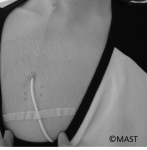
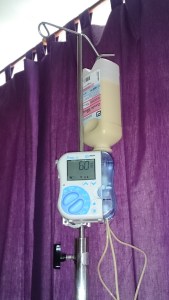
I am on HPN…Home Parenteral Nutrition, also referred to as TPN (Total Parenteral Nutrition) or just PN. This means that every day, for between 10-14 hours, I am connected to a little machine that pumps a specially compounded infusion straight to my bloodstream. The volumes required and repeated infusions would not be possible through the kind of cannula used in hospital – that many will be familiar with –  so I receive my PN through a Hickman Line™. This line is tunnelled through my chest wall through to a central vein (superior vena cava) till it reaches the right atrium of my heart. The line is not taken in and out, it’s held in place by a cuff under the skin. Where it exits, it hangs from my chest with a connecting device on the end, which is what I plug my infusion giving set into each time I set it up. The connecting (and disconnecting) procedures have many steps, but all follow what is known as Aseptic Non Touch Technique (ANNT). This technique – that I was taught in hospital and by my homecare team – is vital to keeping me safe. Anything that enters my line travels round my heart, lungs and brain, therefore entry of air, bacteria or any other organisms / material would lead to serious complications.

So why am I explaining all of this? Well as you may have already guessed from the description above, HPN and all that goes with it, comes with potentially fatal risks. It is considered a form of life support, because that is what it is doing. It is keeping me alive because I am in Intestinal Failure; I cannot get enough nutrients/fluids to survive via my intestinal tract, so it is bypassed altogether. I’m very grateful for HPN…of course because I am still here, but more than that because it allows me to be alive and at home. Originally patients like me would have had to stay in hospital to receive this, which shows what a precious opportunity home life support truly is.

However, the risk level is high, and this is something that never quite leaves my mind. I don’t mind that in itself, it keeps me on my toes, but HPN only works – works safely – when back up through emergency hospital care is available. This is what gives us the confidence to do our care or allow our carers to – the fact that although we are in our homes, we are part of a larger system…our specialist hospital units that know us and know PN, our local hospital emergency departments, our GP’s and ambulance services – that we are a team. Many of the complications that can occur require immediate medical action/support, therefore this back up is vital. All of us on HPN have been through the mill health wise, therefore we have all received a lot of hospital care, met doctors, nurses, dietitians, HCA’s and a wealth of other allied health professionals who have supported us. These highly trained and experienced professionals do an unfathomably amazing job with scant and overwhelmed resources and time.

When I see and hear so much about the current inability of the system to function as it should, to provide beds, to have the funds and resources to meet the care needs of its patients I feel many things. As a person and experienced healthcare professional myself, I feel sadness and anger, but as an HPN’er (as it were) I feel fear. I never know what day something will go wrong, I only know that statistically things will at some point. When the NHS is allowed to function, that’s okay. I put my best foot forward, add a little hope and get on with the job, but currently when I think what will happen in an emergency I feel a staccato beat of terror. What if – through no fault of their own – the emergency backup isn’t there, or it falls short.

The most prominent risk is that of sepsis, where the body responds to an infection by injuring itself, causing shock and organ failure. Sepsis is a medical emergency, the Global Sepsis Alliance talk of the ‘Golden Hour’ – Sepsis treated within the first hour has an 80% survival rate, by the sixth hour the survival rate has dropped to 30% *. Yet awareness of sepsis is low. I am already aware of instances of difficulties with communicating the seriousness of the situation, to encounter this combined with the current pressures could be disastrous.
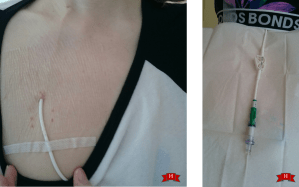
In many ways HPN is a wondrous thing…to receive life support in the comfort of home. At present, that achievement is being debased by the process becoming cloaked with fear. I have to make these connections to live. I know that the flip side is that the process comes with life threatening risks, but every day I work to minimise these through the ANNT process and being as careful as I can. Should it be required, the job of emergency healthcare is to kick in to minimise the effect of complications once they have occurred. I am not alone, there are approximately 2000 HPN patients in the UK, many more depending on other therapies like dialysis and chemotherapy. Healthcare professionals deserve to be able to do their jobs safely, to the standard that they have been taught. Patients deserve to feel confident in the healthcare system, especially emergency healthcare. It is a dreadful indictment for anything less to be the case in our modern world.

* From Saving lives: Treating Sepsis in the Golden Hour. Global Sepsis Alliance. World Sepsis Day 2017.

Home Enteral / Parental Nutrition – A Personal Perspective

In support of PINNT’s Home Artificial Nutrition Week, we wanted to write about the different ways and means a person can get their nutritional needs fulfilled, when they cannot get enough to sustain them otherwise. Such experiences require one or many of the different devices listed in our library. This is a chance to increase awareness of what they can be used for. What better way to describe the process than a personal perspective…

Enteral Nutrition (EN)

Nasogastric (NG) Tube

Nasogastric (NG) tubes are probably the type of device used for feeding that people are most familiar with (though they can be used for other purposes as well) .Probably because it can be seen externally, so most of us have either seen someone in person or through media with one. This was the first type of tube I had, it’s inserted through the nose, down the back of the throat through the oesophagus until it enters the stomach.

Enteral Formula and Pump

I was fed formula through a pump. (I will talk about pump feeding here for all the tubes I had, as that was the method suitable for me). There are lots of different types of formula, the dieticians choose the formula based on the calorie, nutrient and other medical requirements you have. The formula gets connected to a pump through some tubing know as a ‘giving set’. The end of the giving set would then attach to the end of my tube. The pump would be programmed to the rate of delivery. I don’t remember how long my schedules for NG feeding were exactly, but they took most of the day.

Gastrostomy (G tube)

After a little while with the NG tube, I was given a Gastrostomy. This is where an incision is made on the abdomen through to the stomach wall. The stomach wall is pulled up against the abdominal surface to make a stoma. A tube is then inserted through the stoma. The tube (often called a G tube or PEG) has either a plastic bumper or a balloon on the inside (of the stomach) to be prevent it from falling out. It also has a flange to secure it externally. The advantage of a gastrostomy is that it cannot be seen and the stoma can potentially last a lifetime. The process of feeding was otherwise the same; formula delivered via a pump over a long period.

Jejunostomy (J tube)

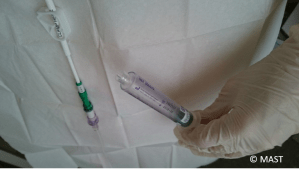
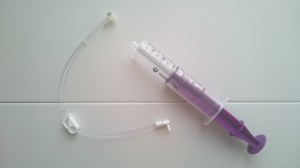
Enteral syringe and extension tube

Unfortunately for me I wasn’t able to get enough calories and nutrients through being fed this way. The next step was to try feeding further down the GI tract to see if my intestines would tolerate it better. This meant having a Jejunostomy. The jejunum is the second part of the small bowel. Once again, a tube is placed through an incision on the abdominal surface, but this time it led to the small bowel. With a J tube feeding has to be via a pump and it is slower compared to feeding to the stomach. The bowel does not have the same kind of capacity, so feeding can be up 24 hrs a day.

It all sounds straightforward, and it’s certainly true that it quickly becomes the new normal. I felt overwhelmed for maybe the first fortnight or so, when I was first at home with each new stoma/device, without the support of the hospital staff, but after that my confidence in the actual process and troubleshooting built quickly. Nonetheless, it is challenging; ordinary activities from the mundane to the social have to be reconfigured. They can be achieved for sure, but a lot also depends on your overall health. For me, I was still very sick and unfortunately all the methods of tube feeding that I tried were just not tolerated by my body, so I was not getting the much needed calories and nutrients throughout all the many many months of different types of tubes and stomas. My weight and health ended up at a critically low point, at that point I started TPN.

Parenteral Nutrition (PN)

Hickman line ®

I had a Hickman line placed so that I could receive parenteral nutrition. The PN goes straight to the bloodstream via the central veins and the heart, thereby avoiding the gastrointestinal system altogether. For people like me with Intestinal Failure, it allows enough us to gain enough nutrition to survive.

Hickman Exit Site and Line

My Hickman line was placed via an incision in my jugular vein, through which the line was inserted, one half threaded down the superior vena cava to the top of the right atrium of my heart, the other half threaded out through another incision about half way down my chest wall. This is where the external section of the line sits. The PN (sometimes refered to us Total Parenteral Nutrition (TPN) or Home Parenteral Nutrition (HPN)), is also administered through a pump system, set to deliver at a particular rate. The initial hospitalisation was lengthy. Unlike formula, PN infusions are compounded to individual requirements. It takes some time to get the prescription right for each person. All connections must be carried out using aseptic technique, as introducing microorganisms has serious and potentially life-threatening consequences. This meant that the process of connecting and disconnecting takes a long time. Even longer at the beginning when I was having to be taught to do the process myself. Added to this, I needed to be treated for refeeding syndrome, having been underweight and deprived of nutrition for such a long term.

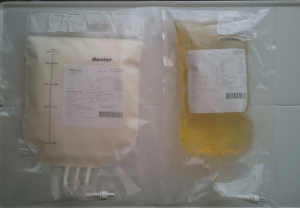
Lipid (fat) and protein PN infusion bags

Coming home with PN was scary. I was concerned about the risks of a line in my heart. In the beginning, I was fearful of making a mistake in the process. It certainly felt like a lot of responsibility to shoulder. I was used to being responsible for my own life of course, but not for running the gauntlet with it on a daily basis. Initially my homecare company sent nurses in everyday, to oversee my training with it and to check how I was doing, which was helpful. There was also a huge amount of supplies to find space for and a full size pharmacy fridge for the TPN (which has to be kept refrigerated). There were a lot of changes to get used too, even figuring out how to shower with 30cm cable in the middle my of chest that cannot get wet! Like with the EN though, I’d did get used to it over time. Also, the fear of sepsis and the other serious complications that can occur, although still present, became less dominant.  I think it’s a good thing to be a little afraid still. It means I am never complacent about my PN routine. I never rush even when I’m tired and very sick, I just say to myself which would you prefer, a few more minutes ensuring everything is fully sterile or sepsis? A no brainer obviously.

Clichéd though it may be…PN saved my life. I wouldn’t be here today, if some great medics had not persisted in finding an alternative way, to get vital nutrients into people like me who’s intestinal tracts had given up altogether. I was malnourished, severely underweight and very sick. I’m still very unwell – my underlying disease has not left – but my weight and nourishment have improved substantially. It isn’t easy, it requires a great deal of time and commitment, it curtails my freedom, and being tied to a machine all day can be very hard. Going away from home is like a military operation! However, if there is something that is really important to do, then with patience, creativity, planning and a little more patience, it can generally be realised, even if it’s just the once. As with enteral feeding, a lot depends on the rest of your health. PN isn’t a one size fits all thing. The best way to find out about the life of someone you see on enteral or parenteral nutrition is to ask. To those who developed PN and those who have helped me and continue to help me live on it now, I would like to say thank you.

For further information visit PINNT

What Lies Beneath Campaign

We are launching our What Lies Beneath campaign to increase awareness about the medical accessories people live with and care for day to day. It is allied to the Not All Disabilities Are Visible movement associated with multiple charities and individuals.

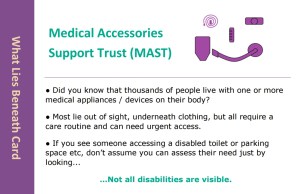
We’ve put together a double sided information card to promote awareness about the existence of hidden  medical accessories, as well as basic information about the different medical appliances and devices, that people may have. Its handy business card size, means single or multiple cards can be carried around in a bag or wallet and used if and when an occasion arises. We’ve also produced an A4 poster with the same information, for places where a static sheet or leaflet would be useful. Both can be downloaded by clicking on the relevant PDF below.
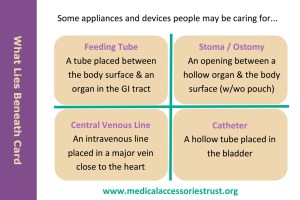
The card and leaflet are particularly aimed at those situations where those of us with hidden accessories can be negatively appraised, challenged or simply misunderstood. Using disabled facilities is a frequent context where this can occur, but there are also many other times when greater understanding and awareness would be helpful. It can be difficult in the moment to know what to say. Sometimes it is just a shake of the head and disapproving look we receive. Those with medical accessories should not have to feel they need give personal information to explain themselves, unless they want to. The recipient will not know which medical appliance / device you have. The card quietly asks others to reappraise the situation, while you go on your way. The front side of the card can also be used alone if preferred. We hope that the recipients understanding will then be carried forward to future situations.

As usual we would like to hear from you, so please contact us if you would like to give feedback about your use of the card.

WhatLiesBeneathCard

WhatLiesBeneathPoster