Living with tube feeding or TPN (feeding to the heart via a central vein), has a significant impact on loved ones who care for and about them. Helping to look after not just the feeding or infusions themselves, but also to assist with the tubes, lines, stomas etc that are needed. Dealing with unexpected problems that inevitably occur and liaising with healthcare professionals. As well as managing the practicalities of delivery of feeds and equipment, stock orders, and storage. It’s a lot to navigate in any relationship. We asked a husband/carer of a person on Home Parenteral Nutrition and a parent of a baby on Home Enteral Nutrition to give us some insight into their perspectives…
Husband / Carer Perspective (HPN)
Working full-time, being a husband and carer for someone on Home Parenteral Nutrition (HPN) is something of a challenge. Things have to run well, if not something has to give. Will the Total Parenteral Nutrition (TPN) delivery allow me to fit in that visit to a client in the community that needs to be seen? Will the GP surgery have sent the correct prescription to the pharmacy this time or will I need to go back to the surgery, explain again to the receptionist that yes it is urgent and necessary? Will my manager understand that if there is an unplanned admission or medical emergency, I need to be there? How do I strike the balance between supporting my wife and supporting my team and how will I get time to see my good friend for a game of pool and a pint?
It is difficult to articulate the struggle to manage competing demands and priorities, but well that is what we do day in day out. If only the system would work a little more smoothly it would help a great deal.
Parent Perspective (HEN)
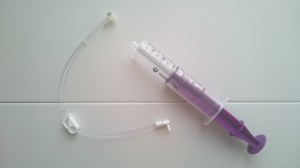
I am a Mum of a baby who has had to have an NG tube for feeding and medications. As a parent the hardest thing is seeing how distressed my daughter becomes when inserting the tube as she can gag and it irritates her throat. I’m also aware she does not get to taste her food. Before any liquid is put down the NG tube, I need to ensure the tube has not moved from her stomach. Aspirate from the stomach needs to be drawn up from through the tube and the PH tested to ensure the liquid is acidic, which confirms the end of the tube is in the stomach. It would be very dangerous to put liquid down the tube if it had moved, particularly if the tube had moved into the lungs. Sometimes it can be hard to obtain aspirate, perhaps because the tube is not far down enough in the stomach, the tube has moved out of the stomach or it is stuck to the stomach wall. It can be distressing when your baby is upset and hungry, and you can’t feed your baby as you’ve not yet obtained any aspirate.
It does get easier with time though, as you get more practised and confident in using the tube. I’ve had a very conflicted relationship with the tube; I am very grateful my baby can be fed and I know she’s getting enough milk. At the same time, I hate that she needs it, she doesn’t like it (so often tries to pull it out) and that other people might treat her differently for it.
Check out PINNT for further information on HPN/HEN
The Lowdown on Enteral and Parenteral Nutrition – Supporting PINNT HAN Awareness 2017
Ever find yourself scratching your head about the terms people use in relation to feeding? New to it and confused? On one type, but not sure of the other? We’ve put together this table to help drill down some specifics… Click on the highlighted terms to read the definition as well as our lived libraryentries. Lots more info can be found at PINNT too.
In support of PINNT’s Home Artificial Nutrition Week, we wanted to write about the different ways and means a person can get their nutritional needs fulfilled, when they cannot get enough to sustain them otherwise. Such experiences require one or many of the different devices listed in our library. This is a chance to increase awareness of what they can be used for. What better way to describe the process than a personal perspective…
Nasogastric (NG) tubes are probably the type of device used for feeding that people are most familiar with (though they can be used for other purposes as well) .Probably because it can be seen externally, so most of us have either seen someone in person or through media with one. This was the first type of tube I had, it’s inserted through the nose, down the back of the throat through the oesophagus until it enters the stomach.
Enteral Formula and Pump
I was fed formula through a pump. (I will talk about pump feeding here for all the tubes I had, as that was the method suitable for me). There are lots of different types of formula, the dieticians choose the formula based on the calorie, nutrient and other medical requirements you have. The formula gets connected to a pump through some tubing know as a ‘giving set’. The end of the giving set would then attach to the end of my tube. The pump would be programmed to the rate of delivery. I don’t remember how long my schedules for NG feeding were exactly, but they took most of the day.
After a little while with the NG tube, I was given a Gastrostomy. This is where an incision is made on the abdomen through to the stomach wall. The stomach wall is pulled up against the abdominal surface to make a stoma. A tube is then inserted through the stoma. The tube (often called a G tube or PEG) has either a plastic bumper or a balloon on the inside (of the stomach) to be prevent it from falling out. It also has a flange to secure it externally. The advantage of a gastrostomy is that it cannot be seen and the stoma can potentially last a lifetime. The process of feeding was otherwise the same; formula delivered via a pump over a long period.
Unfortunately for me I wasn’t able to get enough calories and nutrients through being fed this way. The next step was to try feeding further down the GI tract to see if my intestines would tolerate it better. This meant having a Jejunostomy. The jejunum is the second part of the small bowel. Once again, a tube is placed through an incision on the abdominal surface, but this time it led to the small bowel. With a J tube feeding has to be via a pump and it is slower compared to feeding to the stomach. The bowel does not have the same kind of capacity, so feeding can be up 24 hrs a day.
It all sounds straightforward, and it’s certainly true that it quickly becomes the new normal. I felt overwhelmed for maybe the first fortnight or so, when I was first at home with each new stoma/device, without the support of the hospital staff, but after that my confidence in the actual process and troubleshooting built quickly. Nonetheless, it is challenging; ordinary activities from the mundane to the social have to be reconfigured. They can be achieved for sure, but a lot also depends on your overall health. For me, I was still very sick and unfortunately all the methods of tube feeding that I tried were just not tolerated by my body, so I was not getting the much needed calories and nutrients throughout all the many many months of different types of tubes and stomas. My weight and health ended up at a critically low point, at that point I started TPN.
I had a Hickman line placed so that I could receive parenteral nutrition. The PN goes straight to the bloodstream via the central veins and the heart, thereby avoiding the gastrointestinal system altogether. For people like me with Intestinal Failure, it allows enough us to gain enough nutrition to survive.
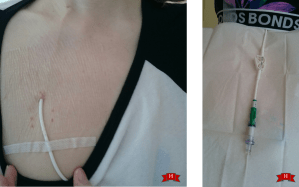
Hickman Exit Site and Line
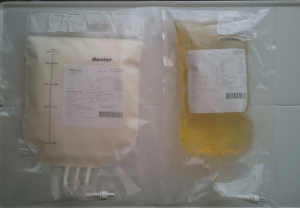
My Hickman line was placed via an incision in my jugular vein, through which the line was inserted, one half threaded down the superior vena cava to the top of the right atrium of my heart, the other half threaded out through another incision about half way down my chest wall. This is where the external section of the line sits. The PN (sometimes refered to us Total Parenteral Nutrition (TPN) or Home Parenteral Nutrition (HPN)), is also administered through a pump system, set to deliver at a particular rate. The initial hospitalisation was lengthy. Unlike formula, PN infusions are compounded to individual requirements. It takes some time to get the prescription right for each person. All connections must be carried out using aseptic technique, as introducing microorganisms has serious and potentially life-threatening consequences. This meant that the process of connecting and disconnecting takes a long time. Even longer at the beginning when I was having to be taught to do the process myself. Added to this, I needed to be treated for refeeding syndrome, having been underweight and deprived of nutrition for such a long term.
Lipid (fat) and protein PN infusion bags
Coming home with PN was scary. I was concerned about the risks of a line in my heart. In the beginning, I was fearful of making a mistake in the process. It certainly felt like a lot of responsibility to shoulder. I was used to being responsible for my own life of course, but not for running the gauntlet with it on a daily basis. Initially my homecare company sent nurses in everyday, to oversee my training with it and to check how I was doing, which was helpful. There was also a huge amount of supplies to find space for and a full size pharmacy fridge for the TPN (which has to be kept refrigerated). There were a lot of changes to get used too, even figuring out how to shower with 30cm cable in the middle my of chest that cannot get wet! Like with the EN though, I’d did get used to it over time. Also, the fear of sepsis and the other serious complications that can occur, although still present, became less dominant. I think it’s a good thing to be a little afraid still. It means I am never complacent about my PN routine. I never rush even when I’m tired and very sick, I just say to myself which would you prefer, a few more minutes ensuring everything is fully sterile or sepsis? A no brainer obviously.
Clichéd though it may be…PN saved my life. I wouldn’t be here today, if some great medics had not persisted in finding an alternative way, to get vital nutrients into people like me who’s intestinal tracts had given up altogether. I was malnourished, severely underweight and very sick. I’m still very unwell – my underlying disease has not left – but my weight and nourishment have improved substantially. It isn’t easy, it requires a great deal of time and commitment, it curtails my freedom, and being tied to a machine all day can be very hard. Going away from home is like a military operation! However, if there is something that is really important to do, then with patience, creativity, planning and a little more patience, it can generally be realised, even if it’s just the once. As with enteral feeding, a lot depends on the rest of your health. PN isn’t a one size fits all thing. The best way to find out about the life of someone you see on enteral or parenteral nutrition is to ask. To those who developed PN and those who have helped me and continue to help me live on it now, I would like to say thank you.

 Living with tube feeding or TPN (feeding to the heart via a central vein), has a significant impact on loved ones who care for and about them. Helping to look after not just the feeding or infusions themselves, but also to assist with the tubes, lines, stomas etc that are needed. Dealing with unexpected problems that inevitably occur and liaising with healthcare professionals. As well as managing the practicalities of delivery of feeds and equipment, stock orders, and storage. It’s a lot to navigate in any relationship. We asked a husband/carer of a person on Home Parenteral Nutrition and a parent of a baby on Home Enteral Nutrition to give us some insight into their perspectives…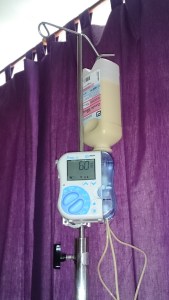
 Medical Accessories Support Trust