

Living with a medical accessory means undergoing changes to the body we are used to living in. It can affect not only the way we see ourselves, but also our perception of how we are seen by others. Whether these changes are welcome, whether or not they are planned, they invoke a process whereby the individual adapts to the new way they look. The way in which each person comes to terms with and goes about living with their accessory is an individual choice.
At MAST we believe it’s important to know options that are out there.
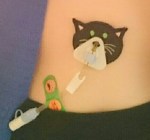 For some people, in addition to choosing the right medical appliances, accessorising in some way can help bring them a sense of ownership, personalisation, incorporation, reclaimation, humour, individuality, beauty, or style, (to name but a few), to their body and accessory. The links and features here explore how others have done this, including those who offer a service to make accessories for other ostomates and tubies.
As usual if you have a way to decorate your medical devices that you would like to share, we want to hear from you. Get in touch here.
Securing IV or Enteral Tubing / Giving Sets
Living with a Central Intravenous Line (CVC), stoma that has a tube for feeding / venting, or a naso-tube, can mean dealing with considerable lengths of tubing. This is particularly the case when the appliance is in use with extension sets running to a metre or so. Even when disconnected, it is not unusual to have approximately 30cm of tubing just hanging around on a chest, abdomen or face! Regardless of mobility and activity level, these things – though greatly beneficial to our health – aren’t always practical. They can get caught, tangled or pulled, get in the way of personal care and get dirty.
There are lots of securement devices around. It’s worth doing some investigating, as it may take some time to find what works best for your own set up. Especially if you have more than one accessory to deal with, you may find you need to get creative with it. Don’t be afraid to look further afield if you need too; you may find the product that works for you was initially developed for a different type. Ask your specialist nurse what might help you.
Below are a couple of basic approaches that can help to secure extra tubing in a simple way, should you want something less clinical. Please note they are not intended for the CVC, ostomy or catheter site itself, which should be secured using medical products as you have been advised by your team.
If you need to secure it to the skin, then simple plasters can work well. 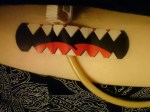 Just line it up so the pad is over the tubing and stick either side as normal. It will allow a small amount of give, so that the tubing can move with your movement.
  The plasters that work best for this are ones where the pad covers the whole of the centre of the plaster. Other than that, you can choose whatever you like, from plain colours, to patterns, characters, words and sayings.
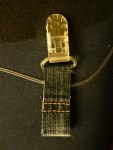 If you’re having trouble with lengths of tubing externally then a simple clasp with a piece of ribbon or material, will achieve the same effect; securing it while still allowing a little natural movement. There is no sewing involved, just cut the ribbon or material to size. Push it through the clasp, and put a piece of stick on Velcro on the ends so you can bring them together.
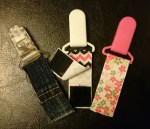 The clasp will clip to your clothing and then you can place the IV or enteral line between the material and close. It can be removed quickly and easily as necessary. Again, you can choose whatever material or ribbon that suits you.
Accessorising a Stoma Pouch
The number one priority for ostomy pouches is clearly their functionality, but once a reliable set up is in place, they can be decorated to reflect your own personal style and needs. It can also help out those of us using clear pouches, for those times when we would prefer and feel more comfortable to have the output covered up. Pouch covers are a great way to achieve this. They can be slipped on and off and washed as needed. You don’t even have to have any sewing skills, as the more proficient ostomists among us make them for all!

Shelley Davey is one such lovely lady, an ostomist herself she has designed a range of pouch covers (pictured). Stomacovers has options available for different ostomies; ileostomy, colostomy, urostomy and gastrostomy, using a wide range of templates. Custom orders can also be arranged if you have specific requirements. There are a range of different designs to choose from, you can check them out here (opens new window).
Using Tubie Pads
These pads are great for stomas that have a tube or low profile (button) device in situ. They sit around the stoma (with a opening for the device) and clip in place. They have the practical purpose of absorbing leakage from the stoma site, helping it keep dry and protecting the skin from gastric / intestinal effluent which can cause granulation. They also protect the stoma, providing a cushion. Materials vary, but they are usually very soft and have multiple layers, given them better absorbency than gauze pads.
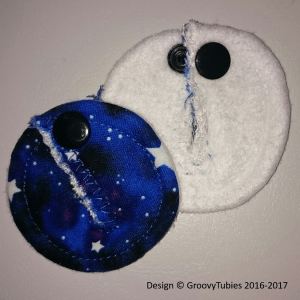 In addition to their practically purpose, they come in a huge variety of different designs, colours and even shapes. Making it another great way of personalising your stoma. Once again, you don’t need sewing skills of your own as folks in the tubie community sell them online. GroovyTubies hand-make a range of tubie pads (pictured) here in the UK. They even make glow in the dark pads! Different types of backing material are available. You can find them here (opens new window).
 Medical Accessories Support Trust